Cheryl & Chris
Cheryl and Chris sent some pictures of their activities this last month. Cheryl writes:
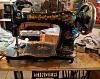
I've mostly been sewing shirts using my quilting stash, but I've also been cleaning up this VS2. The shellac on it was terrible - brown and pealing, plus lots of pitting. Some of the decals were obscured by the darkened and dirty shellac. I've cleaned that up some and smoothed it out a bit using clear shellac, but some of the imperfections such as deep paint chips will still remain. I don't need it to look brand new, but the decals are far brighter and are now protected with a new coating of shellac. It needs a bit more shining up now.
cheryl and chris
 Dianne
From Dianne:
The Johnston Ruffler Company of Ottumwa, Iowa was early to enter the sewing machine attachments business. This ruffler, made of brass, has patent dates going back to Jan. 21, 1863; another Feb. 14, 1865, and several more in 1870, 1871, 1872, 1874 and 1888. The seller had tried to fit it on 1871 and 1875 Howe machines with no luck, but had contact with a woman on Facebook who had a similar ruffler that fit her Wheeler and Wilson sewing machine.
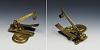
There's no doubt about who manufactured it, with information stamped in four places. Oddly, it is marked "Licensed for Family Use Only" in one spot. An online search found "Manufacturing, Agricultural and Industrial Resources of Iowa" by H.S. Hyatt who wrote this about the company (misspelling the company name): "Johnson Ruffler & Co. - Too much cannot be said in regards to this enterprising company. The energy manifested on their part, and the interest shown in developing the resources of our city, merit the confidence of every citizen. In two short years they have from a limited capital brought their business into general notice, and placed it upon a safe basis financially. They employ 50 hands at an average salary of $2.00 per day, all of which is thrown into circulation amongst the businessmen of our city. Their building is 45 by 90 feet, two stories high, furnished with first class machinery suitable for running their business."
A very different ruffler, as well as a Tuck Marker, also made by the Johnston Ruffler Company, came with a 1898 hand-cranked New National sewing machine by New Home acquired several years ago. The pair are in a burgundy case, and only stamped with company name and town on the ruffler, and a patent date of Nov. 21, 1876 on the Tuck Marker. Directions are in the lid, along with additional patent dates.
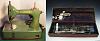
Cleaning up this Standard SewHandy and getting it ready to sew has taken some time. These were manufactured between 1928 and 1938. This one needs a new power cord, and although the present one tests OK with a Ground Fault Circuit Interrupter, it is disintegrating and unsightly. The machine sews nicely. Two books by Darrel P. Kaiser were helpful in working with this machine, "Before the Featherweight Sewhandy" Volume 1 is History, Volume 2 Maintenance and Repair. The books overlap and there is repetition, but they were nevertheless very helpful. To get to the lower gears to grease them, one removes the bottom plate with motor and wiring from the entire top of the machine. The base is aluminum, but the pillar and arm are cast iron. Still, it weighs about the same as a Featherweight, Singer 221. The bobbin is wound on that little stub where the handwheel should be. The later General Electric badged Sewhandy is all cast iron, and that adds about four pounds to its weight. The cases for the Sewhandy and Featherweight are nearly identical.
Dianne
James
James shared the following with us:
I keep losing out on machines I am bidding on so have not acquired anything lately. I finally got my replacement shuttle and bobbins from England that fits my Vickers VS sewing machine. The first shipment never arrived and the seller kindly resent the parts.
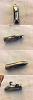
I was able to wind the bobbin fairly well even with the missing parts on the winder. Currently I am having problems forming stitches as the top thread keeps breaking off. Interestingly there is quite a bit of variation between the shuttles after comparing the one I got to the other Vickers and Frister Rossmann compatible shuttles. Mine does not have the carry notch near the pointed end but my machine has a different shuttle cage design that does not require the notch. I also noticed that the machine is pretty picky about the thread placement when placing the shuttle in. If I do not place the thread directly to the front of the machine, the needle will not catch and bring the bobbin thread up.
I have included some photos of the replacement shuttle and bobbin. Notice the hole in the bobbin that fits over a pin in the bobbin winder to hold it in place while winding.
 to be continued....