Here we are again for the May posting of the Colorado Get-Together. April was a very dry month in Colorado, with Denver getting only 6 hundredths of an inch of rain or snow. On May 1st it started raining and we certainly need it.
We have write-ups from several of our members that have sent us their work, along with many pictures. We'll start with Courtney.
Courtney
Courtney, who lives in northern Colorado, has been working on treadlizing a Featherweight. He sends us his write-up and pictures of his success with it:
A couple of weeks ago I had to go to Denver to pick up a quilt I had at the Rocky Mountain Quilt Museum. I met Janey and John for lunch at a Denny's and we had a great time. It was the first time we had seen each other in real life for nearly a year. After my post in January on making a Featherweight treadle, Janey had purchased some 3-1/2 inch pulleys for me from a company going out of business. In additional to our great visit she was able to give me the pulleys.
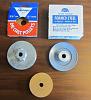
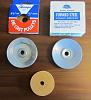
I had originally used homemade wooden pulleys then a cast v-belt pulley from Ace hardware. Both did work. The new formed steel pulleys had with a much narrower bottom than the cast pulleys. They seemed to work much better with the round sewing machine treadle belts. I have now tried three different pulleys for the Featherweight treadle, originally I manufactured pulleys from wood, next I used the cast pulleys form Ace, and finally the formed pulleys from Janey. All three work!
Inside view
Outside view
Groove view
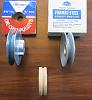 I found it easy to cut the round wooden pulley but it was not easy to make the belt groove. The wooden pulleys are also the easiest to get to work with a stop-motion pin by just pounding a small nail. The only draw back to the wooden pulley is its lack of inertia. It is necessary to use a treadle with a weighted drive wheel. Singer treadles do not work well.
Both of the metal pulleys require a drilled hole to insert the stop-motion pin. I have not done this yet because I have been to the shop yet but that is coming soon. At this point I am using a lock washer and just tightening the screw by hand. Not a good long term solution, but it does work. Both metal pulleys have a greater inertia than the wooden pulley but a treadle with a weighted drive wheel is still recommended. The groove on the cast pulley is flat and wider than a treadle belt. It did work but I but a produce rubber band to increase the traction. The bottom of the formed steel pulley fits a treadle belt perfectly.
Below are pictures that show what has to go onto the Featherweight to make it into a treadle and what has to come off.
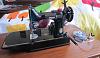
On the left are the parts that need to go on to the machine
The produce rubber band can go in the grove of the drive wheel to allow the bobbin winder to work although the whole mechanism will operate while winding bobbins.
On the left are the two pieces that have to be removed
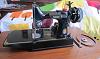
Changing the featherweight into a treadle and back again is very easy and requires no permanent modifications. Note: for a treadle belt I tried a piece of oxygen tubing connected with a staple. It is great for playing around since it does have a bit of stretch and doesn't have to be the exact length for each different setup. Don't know how well it will work long term though. So far I have been pleased with how things are working out. Will send more pictures once I get the stamped pulley drilled with a stop-motion pin and painted black. Till then gook Luck!
Courtney
to be continued...