It's almost October and there is an air of fall here in Colorado. Overnight temperatures are in the forties with day time temperatures in the eighties. Leaves are beginning to turn and many moms are thinking about sewing Halloween costumes for their kids.
We have a few things to present this month, so let's get started.
Dianne
Dianne sends a nice write-up about a Titan machine that she has:
During the last two weeks, this small fiddlebase transverse shuttle Titan machine manufactured by Winselmann in Germany sometime around 1900, was used to sew 36 paper-pieced Economy blocks, 6 inches in size. The top threading was done with old straight-off spools of Dual Duty thread, while the bobbin was threaded with Aurifil to increase its capacity. The machine uses 12x1 needles. Only one foot and one bobbin came with this machine, purchased about a decade ago.
Bobbin winding was a challenge. The bobbin has a hole which must fit on a small pin to get the correct position in the bobbin winder. You seem to need three hands to keep the thread spool steady at starting, keep the thread in the proper guides, and push down to fully engage the small bobbin gear. A small sprung square of metal, enhanced with the titan symbol lifting a treadle, is apparently intended to be held during bobbin winding, as it does push the small gear mostly into contact with the large one. Maybe it is supposed to engage and release when the bobbin is full, which would have been helpful. Actually, without a manual, maybe that is not how it is supposed to work. So holding the area just to the right of where the bobbin is placed on the winder proved to work OK. Once started, the bobbin winds without issues. Threading the shuttle is easy and the shuttle works well except ending a seam with the thread at either end of the bobbin, far away from where the thread is pulled out. Then it sticks a bit and vibrates when pulling the fabric back to cut the threads, and occasionally the thread breaks. Keeping the bobbin tips oiled, and being sure to pull the fabric straight to the back solved this problem.
The machine likes oil, especially on the long glides underneath and on the flywheel. Note there are two oiling holes on the wheel, one toward the machine and one away from it. The lowered, large handwheel is sometimes called Saxony style.
This is a nice little machine. The "boat shuttle" is advanced, compared to the early versions by other makers which just had multiple holes for threading. A metal leaf or flange on the inside towards the tip accepts the thread and guides it to the outside. I did not spot a way to adjust the bobbin thread tension on the shuttle. Adjusting the top thread tension worked fine to obtain a balanced stitch. Using a tweezers makes inserting the bobbin into the shuttle much easier, the bobbin holder on the flat end having a spring. The shuttle drops neatly into place. The bottom thread is captured and pulled up without issues after the shuttle is reinserted. It works best to stop sewing with the takeup lever at its highest point, whence you can start again without needing to hold the threads and there will be no tangled or lumpy threads. This is handy for inside seams in paper piecing, and almost any sewing situation. Nearly all machines seem to work this way. Sometimes removing the shuttle requires a bit of finesse getting it into full left position. A quick pull to the left will then pop it up to be easily removed. The stitch length adjusts appropriately.
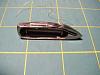
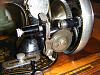
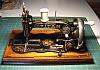
The wood base with lovely inset inch and centimeter grids, is about 9" x 16".
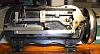
Note the little titan on the center underside of this machine. Apparently Winselmann called several of their models Titan, making it difficult to find correct manuals and dating information.
The plan is to use and report on one machine each month. It will take several years to make my way through the herd.
Dorothy
Dorothy sent a note about a machine that she has at home. She writes:
Hello!
A month of nothing and the last 3 days!
I may have found the Griest model 10 buttonholer for high shank Necchi which might work on my Juki2010Q shirt maker! Seems to be a rare model as 6 months looking and this the first seen!
I am also trying to identify a Singer Treadle stand I might procure. I can find nothing in Ismacs. It is the one which has Prairie Styling aka Frank Wright. Metal legs. It will live in the shed.
Thanks so much! I will write up next month what I do find out on these subjects.
Dorothy
In a second, later note Dorothy wrote:
Hello!
I retire at the end of this week after 28 years designing for automotive. I look forward to it.
What to do now?
Organize! There is so much in my sewing room that is duplicated (not just sewing machines) and sorting should allow more room to set up and sew. I have been looking at drafting information with enthusiasm as I have not been designing clothing in maybe 10 years.
First up is a costume for my Son for Halloween which is his Birthday. He has requested a character from an Anime that is wearing rather traditional Japanese Hakima and Robes. There will be a white underlayer with a longer Kimono over the top.
I look forward to the meeting!
Dorothy
Courtney
Courtney has been busy with a History Fest. He sends the following notes about his activities over the last month:
I was hoping that I could get a picture of History Fest today but I was just too busy, Sorry! Here is my monthly report:
At last month's Zoom meeting I mentioned I had some veneer that Chris might be able to use. The next weekend Chris and Cheryl were up this way and so they dropped by. We spent most of a Saturday afternoon just talking and solving the World's problems. Great day!
My sewing machine time this month has been spent mostly on getting ready for History Fest. For a week in the spring and a week in the fall the Greeley Museums host History Fest at Centennial Village. It is mostly for 4th graders. They get to see a blacksmith forge a nail, get to scrub clothes on a washboard, and attend a one room schoolhouse. I take a number of vintage and antique sewing machines and talk about how the sewing machine has changed our daily lives. After teaching high school and college for over 50 years, it is fun to talk to real kids again. I have a great time although my voice gets a bit raspy because I am not used to talking all day long like I once was.
A couple of months ago I reported that I had bought a Singer 201-2. I am now working on changing it to a 201-3 so that I can use it with an exterior motor, a treadle or a hand crank. I have a belt guard and bobbin winder from an old Japanese model 15 clone that works fine. I have also found another Japanese zig-zag machine that I think will work. I will give it a try when I get a chance. Perhaps while I have it converted, I will have a chance to work on the potted motor and get it working safely again. I am rather wary to try it without rewiring.
Til next month,
Courtney
Janey was able to find the webpage for the High Plains History Festival at
https://greeleymuseums.com/historyfestival/ and probably an older picture of Courtney at
https://greeleymuseums.com/wp-conten...t1609-1028.jpg
John
Lastly, John describes a project that he worked on some time ago. He writes:
I thought I might take this opportunity to mention something I did several years ago.
I should begin by saying that I don't sew very much. Janey does that for both of us. With years of experience, she is very accomplished. But I do observe, watch others and read. Sometimes I think I can contribute a gizmo or gadget that will help, sort of in a support role.
Several years ago, I thought to myself that there had to be a better way to hold and work on old sewing machines. Machine heads are heavy, they're unwieldy and are hinged from the bottom, making them very top heavy. Many parts of a sewing machine are very fragile. I've seen bent spool pins. I've seen machines rolled around and propped up. I've seen machines placed on their front or back, in order to access something on the underside.
I thought that an extremely sturdy frame, that the machine could be attached to, might be rotated from a point closer to its center of gravity. I built a workstand for doing just that. As the project progressed, I made interchangeable baseboards to accommodate a wide variety of sewing machines with their different footprints.
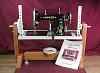 A few other people saw it and wanted one. So I made a few for others, as well. That was a long time ago and I am not intending on making any more of them. But the old thread offers pretty good instructions for anyone wanting to make their own.
The thread is a bit lengthy, since I wrote it step-by-step as things progressed. Anyone with an eye toward being easy on themselves, as well as giving safe and gentle care to these delicate old sewing machines, might find interest in the idea.
The thread may be found at:
Sewing Machine Work Stand
I hope that it's interesting and useful.
John
In Closing
We hope that everyone has a good October. We will post here again next month. Until then, thank you for reading.